Tree Trimming Ridgefield WA for Healthy Growth and Safer Properties
Arbor City Tree Care provides professional Tree Service and Tree Trimming in Ridgefield, WA for homeowners, businesses, and commercial property owners who need to manage deadwood, overgrown branches, structural growth, building clearance, and mature trees before small concerns become larger problems. Ridgefield’s mix of established properties, newer residential development, street trees, and growing commercial areas means pruning often has to balance tree health with the practical space needed around homes, sidewalks, streets, driveways, and businesses.
Professional trimming should accomplish something specific.
It may remove dead or damaged branches, establish better structure in a younger tree, provide clearance around a roof, or address limbs extending over a frequently used portion of a property.
The objective is not simply to make a tree smaller.
Arbor City Tree Care provides Tree Pruning, thinning, safety pruning, tree and shrub maintenance, inspections, cabling, bracing, removal, and other tree-care services. The company also offers assessments and free estimates and states that its arborist expertise includes evaluating tree health, soil and root conditions before recommending work.
Schedule a tree assessment with Arbor City Tree Care when the branches on your Ridgefield property need professional attention rather than another round of indiscriminate cutting.
Prune for a Reason, Not Just Because the Tree Has Grown
Trees are supposed to grow.
A larger canopy is not automatically a maintenance problem.
The question is whether that growth is creating a specific issue with the tree’s structure, surrounding property, or the way people use the area underneath it.
That distinction is especially important with mature trees.
Dead and Damaged Branches Above Active Areas
Deadwood deserves attention according to where it is located.
A dead branch above an isolated portion of a large property presents a different concern from one positioned over a driveway, patio, sidewalk, parking space, business entrance, or children’s play area.
Professional Tree Pruning can selectively address dead and damaged material without automatically treating healthy canopy as part of the problem.
If deadwood appears alongside other changes—such as widespread canopy thinning, unusual fungal growth, trunk damage, or root-zone changes—the tree may benefit from a broader inspection before pruning begins.
Arbor City Tree Care’s tree specialists can assess those conditions and discuss whether pruning, monitoring, another maintenance approach, or Tree Removal makes more sense.
Branches Competing With Houses, Roofs, and Driveways
A tree can remain healthy while becoming increasingly inconvenient for the property around it.
Branches may extend toward roofing, gutters, siding, driveways, fences, or neighboring private property.
This is where selective clearance pruning becomes valuable.
Instead of heavily reducing the entire side of a tree, professional tree workers can identify the limbs creating the conflict and consider how removing them will affect the remaining structure.
Arbor City Tree Care specializes in close-quarter tree maintenance and works around houses, businesses, and other property features where access and branch movement need to be carefully controlled.
That capability can be particularly useful on tighter residential properties where there is no large open landing area underneath the canopy.
Young Trees That Need Structural Attention Early
Some of the most valuable pruning happens long before a tree becomes enormous.
Younger trees may develop:
- Crossing branches
- Competing stems
- Crowded growth
- Poorly positioned limbs
- Branches that will eventually conflict with streets or structures
Addressing those conditions while branch diameters are smaller can be preferable to waiting until major corrective cuts are required.
For Ridgefield homeowners establishing newer landscapes, periodic structural evaluation can become part of a long-term maintenance plan rather than waiting until trees outgrow their available space.
Our Extensive Tree Maintenance Services
Here are the high-quality tree service options we provide:
- tree pruning
- tree thinning
- bush pruning
- safety pruning
- tree and bush maintenance
- tree cabling
- tree bracing
- lightning protection
Ridgefield Street Trees Need Specific Clearance
Street trees create one of the clearest reasons this page should be different from our other Ridgefield content.
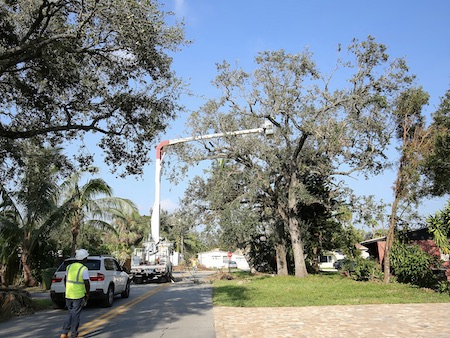
The City of Ridgefield says street trees within the right-of-way adjacent to private property are generally the responsibility of the property owner to maintain. Current City guidance calls for at least 9 feet of clearance above sidewalks or walkways and 13.5 feet on the street side so pedestrians, cyclists, vehicles, and larger service equipment can move safely.
That creates a practical pruning objective.
A street tree may be healthy but still require maintenance because lower branches interfere with:
- Pedestrian movement
- Vehicle clearance
- Visibility
- Parking
- Street maintenance
- Bicycle movement
The answer should still be thoughtful pruning rather than aggressive canopy reduction.
Ridgefield specifically directs property owners who cannot perform appropriate street-tree trimming themselves to consider contacting an arborist.
That gives professional trimming two jobs:
Create the clearance Ridgefield requires while maintaining appropriate tree structure.
Major Street-Tree Pruning Is Different From Ordinary Trimming
Another important local distinction is how much pruning is being performed.
Ridgefield Municipal Code defines minor pruning as work involving water sprouts, suckers, twigs, branches under two inches in diameter, or pruning affecting less than 10% of foliage-bearing area. Deadwood removal is also included within the City’s definition of minor pruning.
Major pruning is treated differently.
Under the City’s code, major pruning includes removing branches two inches or larger, root pruning, or work affecting more than 10% of the tree’s foliage-bearing area. For street trees in planting strips, improved rights-of-way, or other public places, major pruning requires a street-tree permit.
The City can also require major pruning to be completed by a licensed and bonded arborist as part of that permit process. Tree topping is prohibited as a normal practice.
That is an important distinction for a Ridgefield property owner looking at an overgrown street tree.
Routine maintenance and removing some deadwood are not necessarily the same project as taking several large structural limbs from the canopy.
Before substantial street-tree pruning begins, establish what category the proposed work falls into.
Heritage Trees Require Another Level of Care
Ridgefield also regulates designated heritage trees differently from ordinary landscape trees.
Current development code allows the crown of a heritage tree to be pruned without director approval when at least 80% of the existing crown remains undisturbed. Pruning more than 20% requires approval and must follow acceptable arboricultural standards, protect public and private property, and be completed by a qualified professional.
This is another reason heavy canopy reduction should not be treated casually.
If you are unsure whether a large established tree has protected status, determine that before planning extensive work.
For ordinary pruning as well, the same principle remains useful:
Remove what the objective requires without unnecessarily removing healthy canopy.
Tree Trimming Should Support Long-Term Tree Health
Pruning changes a living structure.
Every cut affects what remains.
That is why professional tree care standards matter more than how quickly branches can be removed.
Arbor City Tree Care offers multiple maintenance approaches, including pruning, thinning, safety pruning, cabling, bracing, and tree-health evaluation. Before maintenance, the company’s process can include inspecting soil conditions, root protection, and signs of disease.
This broader evaluation can be useful when a homeowner initially believes trimming is the obvious answer.
Suppose the canopy is thinning.
Removing additional branches may not address the reason.
Or perhaps one large branch has a structural concern. The appropriate conversation may involve pruning, cabling or bracing, monitoring, or another solution rather than simply reducing the whole tree.
Likewise, there are cases where Tree Removal is more appropriate than repeatedly pruning a tree with substantial structural or health problems.
Good tree service means being able to recognize the difference.
Pruning Before Storm Damage Is Different From Responding After It
Preventative pruning can address identifiable concerns before Pacific Northwest weather exposes them.
That does not mean dramatically thinning every tree before winter.
Instead, planned maintenance may focus on known deadwood, damaged branches, structural issues, or other specific conditions.
After a storm, the priorities change.
A broken limb may remain suspended in the canopy.
A tree can lose a major branch while other portions remain standing.
The root zone may show movement.
Or a tree may partially fail onto a driveway, building, or other occupied portion of the property.
Keep people and vehicles away from unstable trees and hanging material.
If power lines are involved, do not approach or attempt to prune the tree. Contact the appropriate utility or emergency authority.
Once immediate hazards are controlled, the remaining tree can be evaluated to determine whether corrective pruning is appropriate or whether emergency tree removal is necessary.
Losing one branch does not automatically mean losing the whole tree.
Tree Maintenance That Can Change With Your Ridgefield Property
Arbor City Tree Care provides more than pruning, which becomes useful when an assessment reveals that the project has a different scope than expected.
The company’s Ridgefield tree-care services include pruning, thinning, cabling, bracing, Tree Removal, inspections, and broader maintenance. It also handles lot-clearing work and close-quarter removal.
That means a homeowner does not have to decide the solution before requesting an assessment.
A tree might need trimming.
Another could need ongoing monitoring.
A larger structural issue might lead to a different recommendation.
And if multiple trees need to come out for construction or a substantial property change, Land Clearing, stump grinding, or Stump Removal may become more relevant than ordinary maintenance.
This flexibility is useful in a growing community like Ridgefield, where trees often have to coexist with additions, newer landscaping, changing streetscapes, and ongoing property improvements.
Contact Arbor City Tree Care to request a tree assessment and free estimate for professional Tree Trimming in Ridgefield, WA.
Keep Ridgefield Trees Working With the Property Around Them
Good tree trimming is often preventative.
A younger tree can receive structural attention before problematic branches become large.
A mature tree may need deadwood removed before it falls into an active area.
Branches approaching a roof can be managed before they become a larger clearance problem.
And Ridgefield street trees can be maintained before low branches interfere with sidewalks and road traffic.
The objective changes from tree to tree.
The pruning should change with it.
Arbor City Tree Care provides Tree Trimming Ridgefield WA property owners can use for planned maintenance, structural pruning, clearance concerns, and more complicated tree conditions around homes and businesses. Its broader tree-care capabilities also mean that when trimming is not the right solution, the conversation can move toward the service the tree actually requires.
Contact Arbor City Tree Care to schedule a tree assessment and request a free estimate for professional tree trimming in Ridgefield, WA.
Tree Trimming FAQs for Ridgefield, Washington
Arbor Tree Care Offers Tree Services in the Following Locations
Camas | Battle Ground | Salmon Creek